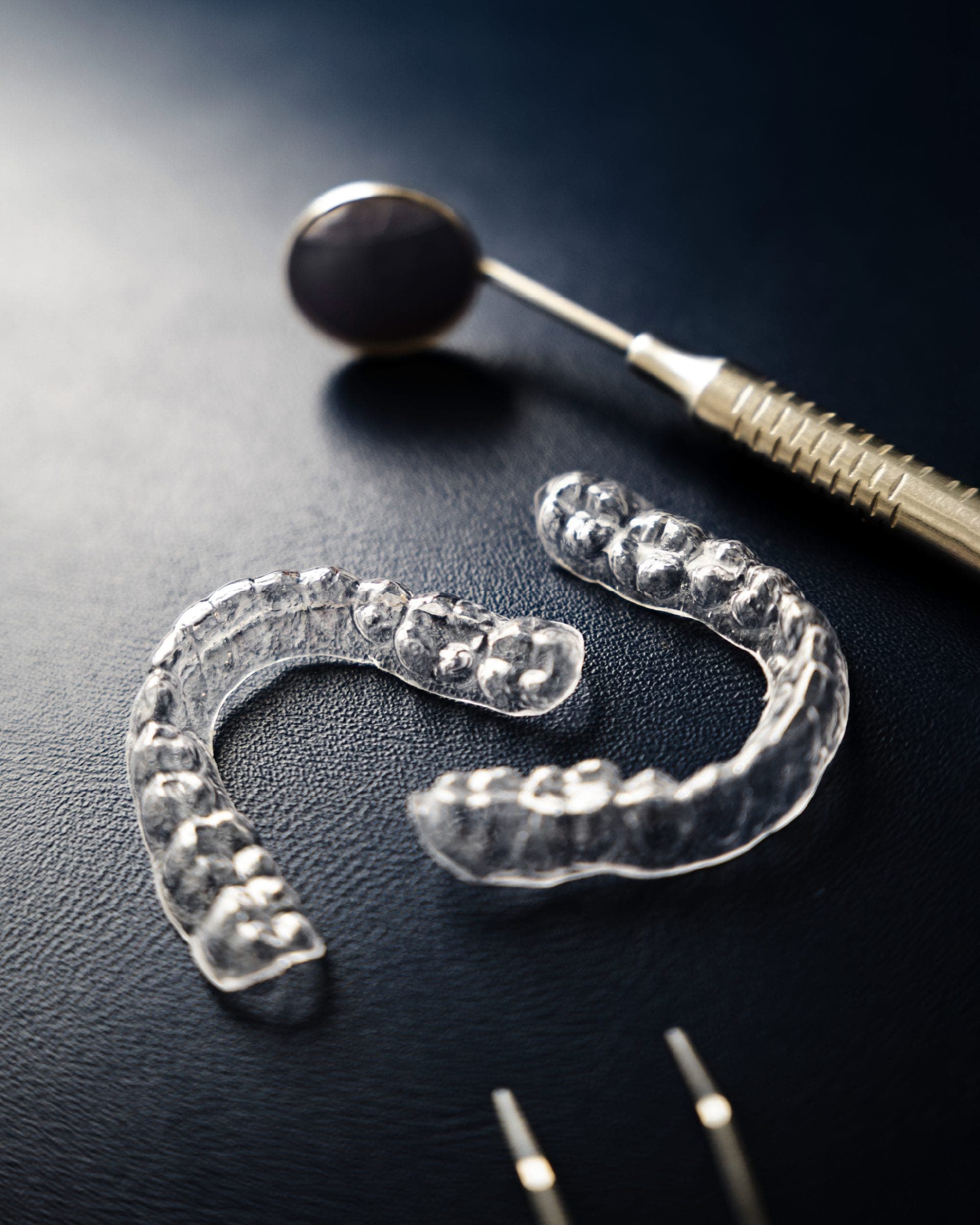
Invisible Aligner Treatment
Invisible aligners are a series of clear, thin plastic trays custom-made to fit your teeth. Each tray is shaped slightly differently, gradually moving the teeth into a planned position. They are nearly invisible and can be removed for eating and cleaning, making them a discreet alternative to braces for many people.
- Daily wear
- About 20–22 hours
- Treatment time
- Often 6–24 months
- Aligner changes
- Roughly every 1–2 weeks
Who it suits.
- Crowded or crooked teeth
- Gaps between teeth
- Many mild to moderate bite problems
- Adults and teens who want a discreet, removable option
What it brings.
Nearly invisible
Clear trays are hard to notice in everyday life.
Removable
You take them out to eat, drink anything other than water, brush and floss.
Comfortable
Smooth plastic avoids the wires and brackets that can rub with braces.
Planned in advance
Digital planning shows the intended tooth movement before you start.
Step by step.
- 01
Assessment and scan
Your dentist or orthodontist takes photos, X-rays and a digital scan of your teeth to see whether aligners suit your case.
- 02
Digital treatment plan
Software maps how each tooth will move step by step, and you can often see a preview of the expected result.
- 03
Wearing the aligners
Small tooth-colored attachments may be bonded to some teeth, and you switch to a new set of trays roughly every one to two weeks.
- 04
Progress checks
Regular check-ups make sure the teeth are moving as planned, with refinements if needed.
- 05
Retainers
When the teeth reach their final position, retainers are used to stop them drifting back.
Looking after it.
- Wear aligners for about 20–22 hours a day, removing them only to eat, drink and clean
- Brush your teeth before putting the aligners back in to avoid trapping food
- Rinse and gently clean the trays daily; avoid hot water, which can warp them
- Wear your retainers exactly as instructed once treatment ends, usually nightly for the long term
Good to know.
How long does aligner treatment take?
It depends on how much the teeth need to move. Simple cases can take around six months, while more complex ones may take a year or two.
Do aligners hurt?
Most people feel some pressure or mild soreness for a day or two when they start a new set of trays. This is a sign the teeth are moving and usually fades quickly.
Can aligners fix every case?
Not always. Aligners work well for many types of crowding, spacing and bite problems, but some severe or complex cases are better treated with fixed braces or a combined approach.
Explore more.


Discover the
Power of change.

In their own words.

“I'm very happy with my experience! The team was professional, and the treatment was top-quality. I saved a lot on my dental work without compromising on care. Highly recommend!”

“The clinic exceeded my expectations! The staff was friendly, and the care was excellent. I got a full smile makeover at an unbeatable price. Very satisfied!”

“I was nervous at first, but the team made me feel comfortable and the treatment was painless. I'm thrilled with the results and the savings. I highly recommend it!”

“Great dental care at an affordable price. The team was friendly and professional, and I'm really happy with the results. Highly recommend the clinic!”